

Psoriasis is a skin disease that causes red, itchy scaly patches, most commonly on the knees, elbows, trunk and scalp.
Psoriasis is a common, long-term (chronic) disease with no cure. It tends to go through cycles, flaring for a few weeks or months, then subsiding for a while or going into remission. Treatments are available to help you manage symptoms. And you can incorporate lifestyle habits and coping strategies to help you live better with psoriasis.
Causes
Psoriasis is thought to be an immune system problem that causes the skin to regenerate at faster than normal rates. In the most common type of psoriasis, known as plaque psoriasis, this rapid turnover of cells results in scales and red patches.
Just what causes the immune system to malfunction isn’t entirely clear. Researchers believe both genetics and environmental factors play a role. The condition is not contagious.
Psoriasis triggers
Many people who are predisposed to psoriasis may be free of symptoms for years until the disease is triggered by some environmental factor. Common psoriasis triggers include:
Infections, such as strep throat or skin infections
Weather, especially cold, dry conditions
Injury to the skin, such as a cut or scrape, a bug bite, or a severe sunburn
Stress
Smoking and exposure to secondhand smoke
Heavy alcohol consumption
Certain medications — including lithium, high blood pressure medications and antimalarial drugs
Rapid withdrawal of oral or systemic corticosteroids
Symptoms
Psoriasis signs and symptoms can vary from person to person. Common signs and symptoms include:
Red patches of skin covered with thick, silvery scales
Small scaling spots (commonly seen in children)
Dry, cracked skin that may bleed or itch
Itching, burning or soreness
Thickened, pitted or ridged nails
Swollen and stiff joints
Psoriasis patches can range from a few spots of dandruff-like scaling to major eruptions that cover large areas. The most commonly affected areas are the lower back, elbows, knees, legs, soles of the feet, scalp, face and palms.
Most types of psoriasis go through cycles, flaring for a few weeks or months, then subsiding for a time or even going into remission.
There are several types of psoriasis, including:
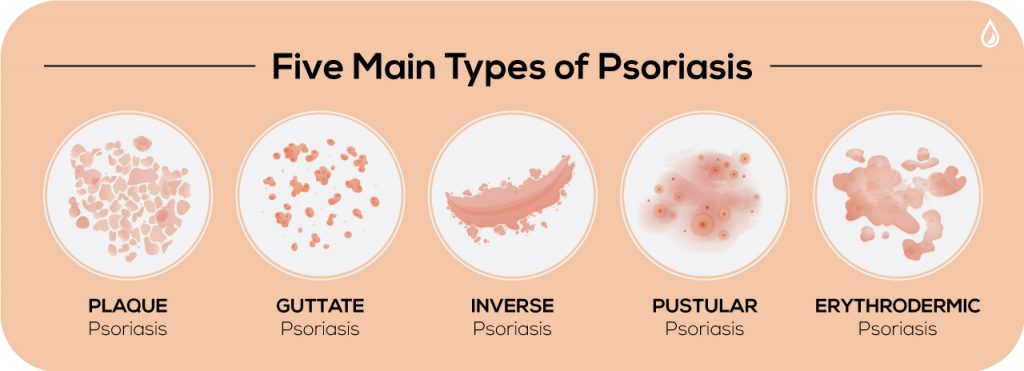
Plaque psoriasis. The most common form, plaque psoriasis causes dry, raised, red skin patches (lesions) covered with silvery scales. The plaques might be itchy or tender, and there may be few or many. They usually appear on elbows, knees, lower back and scalp.
Nail psoriasis. Psoriasis can affect fingernails and toenails, causing pitting, abnormal nail growth and discoloration. Psoriatic nails might loosen and separate from the nail bed (onycholysis). Severe cases may cause the nail to crumble.
Guttate psoriasis. This type primarily affects young adults and children. It’s usually triggered by a bacterial infection such as strep throat. It’s marked by small, drop-shaped, scaling lesions on the trunk, arms or legs.
Inverse psoriasis. This mainly affects the skin folds of the groin, buttocks and breasts. Inverse psoriasis causes smooth patches of red skin that worsen with friction and sweating. Fungal infections may trigger this type of psoriasis.
Pustular psoriasis. This rare form of psoriasis causes clearly defined pus-filled lesions that occur in widespread patches (generalized pustular psoriasis) or in smaller areas on the palms of the hands or the soles of the feet.
Erythrodermic psoriasis. The least common type of psoriasis, erythrodermic psoriasis can cover your entire body with a red, peeling rash that can itch or burn intensely.
Psoriatic arthritis. Psoriatic arthritis causes swollen, painful joints that are typical of arthritis. Sometimes the joint symptoms are the first or only symptom or sign of psoriasis. And at times only nail changes are seen. Symptoms range from mild to severe, and psoriatic arthritis can affect any joint. It can cause stiffness and progressive joint damage that in the most serious cases may lead to permanent joint damage.
Risk factors
Anyone can develop psoriasis. About a third of instances begin in the pediatric years. These factors can increase your risk:
Family history. The condition runs in families. Having one parent with psoriasis increases your risk of getting the disease, and having two parents with psoriasis increases your risk even more.
Stress. Because stress can impact your immune system, high stress levels may increase your risk of psoriasis.
Smoking. Smoking tobacco not only increases your risk of psoriasis but also may increase the severity of the disease. Smoking may also play a role in the initial development of the disease.
Complications
If you have psoriasis, you’re at greater risk of developing other conditions, including:
Psoriatic arthritis, which causes pain, stiffness and swelling in and around the joints
Eye conditions, such as conjunctivitis, blepharitis and uveitis
Obesity
Type 2 diabetes
High blood pressure
Cardiovascular disease
Other autoimmune diseases, such as celiac disease, sclerosis and the inflammatory bowel disease called Crohn’s disease
Mental health conditions, such as low self-esteem and depression
The list of some Psoriasis medicine: